




ChatGPT vs DeepSeek: Which AI Platform Wins in 2026?
ChatGPT vs DeepSeek! ChatGPT, developed by OpenAI, and DeepSeek, built by a Chinese AI research lab, are two of the most capable AI platforms available today. ChatGPT leads in ecosystem integration,...

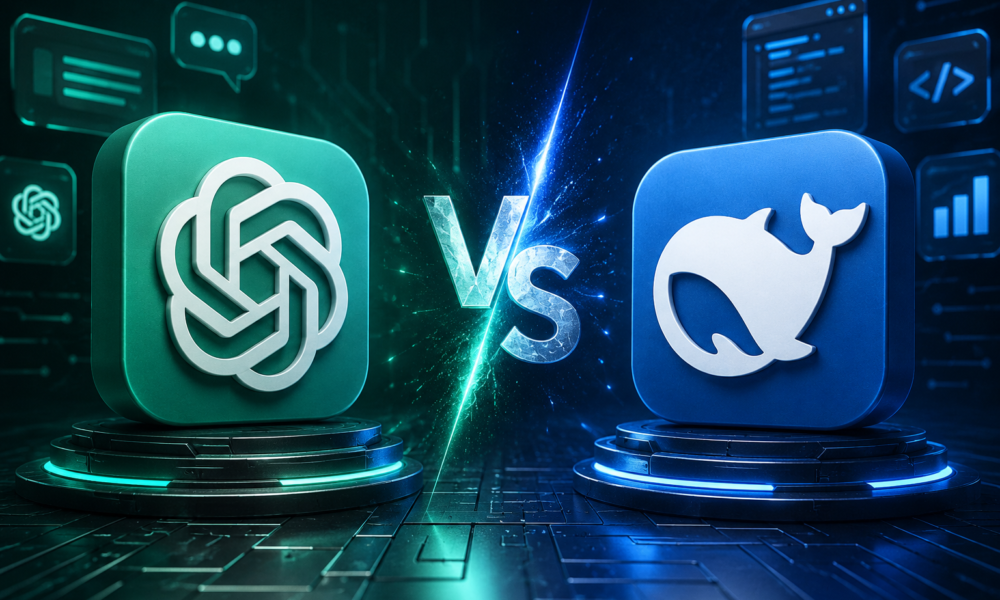
ChatGPT vs DeepSeek! ChatGPT, developed by OpenAI, and DeepSeek, built by a Chinese AI research lab, are two of the most capable AI platforms available today. ChatGPT leads in ecosystem integration, creative tasks, and ease of use. DeepSeek stands out for cost efficiency, technical reasoning, and multilingual performance—particularly for users in Asian markets.
Table Of Content
- What Is ChatGPT?
- What Is DeepSeek?
- Key Differences: ChatGPT vs DeepSeek Head-to-Head
- How do their training data and knowledge cutoffs compare?
- How do their model architectures differ?
- Which platform handles multiple languages better?
- Which AI platform responds faster?
- Features Comparison
- Natural Language Understanding and Generation
- Code Generation and Technical Problem-Solving
- Creative Writing and Content Generation
- Data Analysis and Research Capabilities
- Integration With Third-Party Tools and APIs
- Performance Benchmarks: How Do They Actually Compare?
- Pricing and Cost Analysis
- User Experience and Accessibility
- Which AI Platform Should You Choose?
- When ChatGPT is the better choice
- When DeepSeek is the better choice
- Quick Decision Matrix
- Where Does This Leave You?
- Frequently Asked Questions
Two platforms are dominating conversations about the future of AI: ChatGPT and DeepSeek. Both are powerful. Both are evolving rapidly. And both are reshaping how individuals and businesses interact with technology. But they’re not the same—and choosing between them can have real consequences for your productivity, budget, and outcomes.
This post breaks down the key differences between ChatGPT and DeepSeek across features, performance, pricing, and user experience. By the end, you’ll know exactly which platform fits your needs—and why.
What Is ChatGPT?
ChatGPT is a conversational AI platform developed by OpenAI, a San Francisco-based research company co-founded in 2015. Built on the GPT (Generative Pre-trained Transformer) architecture, ChatGPT became a cultural phenomenon after its public launch in November 2022—reaching one million users within five days and 100 million within two months, making it one of the fastest-growing applications in history.
Core capabilities include:
- Natural language understanding and generation
- Code writing, debugging, and explanation
- Creative writing, summarization, and editing
- Image generation (via DALL·E integration in GPT-4o)
- Web browsing and real-time information retrieval (on paid plans)
Pricing:
- Free tier: Access to GPT-4o with usage limits
- ChatGPT Plus: $20/month — faster responses, priority access, advanced tools
- ChatGPT Pro: $200/month — unlimited access to the most advanced models
- API access: Priced per token; varies by model
ChatGPT is available via web, iOS, and Android apps, and integrates with tools like Microsoft Copilot, Zapier, and thousands of third-party platforms.
What Is DeepSeek?
DeepSeek is an AI platform developed by DeepSeek AI, a Chinese research lab founded in 2023 and backed by the quantitative hedge fund High-Flyer. Despite being a relative newcomer, DeepSeek made headlines globally in early 2025 when its R1 model matched—and in some benchmarks, outperformed—leading Western AI models at a fraction of the training cost.
DeepSeek’s rise is significant not just for its performance, but for what it signals: that frontier AI development is no longer the exclusive domain of Silicon Valley.
Core capabilities include:
- Advanced mathematical and logical reasoning
- Code generation and technical problem-solving
- Multilingual support with strong Chinese-language performance
- Research-grade data analysis
- Long-context document processing
Pricing:
- Free tier: Available via DeepSeek’s web app and mobile app
- API access: Significantly cheaper than OpenAI’s — DeepSeek-V3 input tokens cost approximately $0.27 per million tokens, compared to GPT-4o’s $2.50 per million tokens
- No premium subscription tier as of mid-2025
For cost-sensitive users and developers, DeepSeek’s pricing alone makes it worth serious consideration.
Key Differences: ChatGPT vs DeepSeek Head-to-Head
How do their training data and knowledge cutoffs compare?
ChatGPT’s GPT-4o has a knowledge cutoff of early 2024, with real-time web access available on paid plans. DeepSeek-V3 and R1 have a knowledge cutoff of July 2024, but do not currently offer native web browsing.
For users who need current information, ChatGPT’s browsing capability gives it a practical edge.
How do their model architectures differ?
ChatGPT uses a dense transformer architecture. DeepSeek-V3 uses a Mixture of Experts (MoE) architecture, which activates only a subset of parameters per query. This makes DeepSeek computationally efficient—reportedly trained for under $6 million, compared to the hundreds of millions typically associated with comparable models.
Which platform handles multiple languages better?
Both platforms support multiple languages. ChatGPT performs strongly across European languages. DeepSeek has a measurable advantage in Chinese-language tasks, given its training data composition and the team’s linguistic focus. For businesses operating across Asian markets, this is a meaningful differentiator.
Which AI platform responds faster?
DeepSeek-V3 is notably fast for standard queries. ChatGPT’s response speed varies depending on the model and server load—GPT-4o is generally quick, but the more advanced o1 and o3 reasoning models are slower due to their chain-of-thought processing.
Features Comparison
Natural Language Understanding and Generation
Both platforms produce fluent, coherent text. ChatGPT has a slight edge in tone flexibility and creative nuance—likely a result of its extensive RLHF (Reinforcement Learning from Human Feedback) training. DeepSeek matches it closely for factual and technical writing, though some users report its outputs feel slightly more formal.
Code Generation and Technical Problem-Solving
This is where DeepSeek genuinely shines. DeepSeek-R1’s performance on coding benchmarks—including HumanEval and SWE-bench—rivals or exceeds GPT-4o. Developers building complex systems or working through multi-step technical problems have found DeepSeek-R1 particularly capable at showing its reasoning, step by step.
Creative Writing and Content Generation
ChatGPT holds a clear advantage here. Its ability to adopt distinct voices, write in different styles, and produce long-form creative content with narrative coherence is more refined. For marketers, novelists, and content teams, ChatGPT remains the stronger choice.
Data Analysis and Research Capabilities
ChatGPT’s Code Interpreter (now called Advanced Data Analysis) allows users to upload files, run Python code, and generate visualizations directly in the chat. DeepSeek handles analytical reasoning well but lacks this built-in data processing environment, making ChatGPT more practical for data-heavy workflows.
Integration With Third-Party Tools and APIs
ChatGPT has a significant ecosystem advantage. Through the OpenAI API, it powers thousands of applications, plugins, and automations. DeepSeek’s API is growing in adoption—partly due to pricing—but its third-party integrations are not yet as mature.
Performance Benchmarks: How Do They Actually Compare?
On the MMLU benchmark (measuring multitask language understanding), GPT-4o and DeepSeek-V3 score comparably, both exceeding 85%. On MATH benchmarks, DeepSeek-R1 has demonstrated exceptional performance, reportedly scoring above 90%—on par with OpenAI’s o1 model.
For coding tasks, DeepSeek-R1 scored 96.3% on HumanEval in early 2025 benchmarks, placing it among the top-performing models globally.
Across creative and open-ended tasks, third-party evaluations consistently place ChatGPT ahead—particularly for subjective quality metrics like engagement, style, and originality.
Neither platform is universally superior. Performance depends heavily on the task type.
Pricing and Cost Analysis
|
ChatGPT |
DeepSeek |
|
|---|---|---|
|
Free Tier |
Yes (GPT-4o, limited) |
Yes (full access) |
|
Paid Plan |
$20–$200/month |
No subscription tier |
|
API Input Cost |
~$2.50/1M tokens (GPT-4o) |
~$0.27/1M tokens (V3) |
|
API Output Cost |
~$10/1M tokens (GPT-4o) |
~$1.10/1M tokens (V3) |
|
Enterprise Options |
Yes |
Growing |
For individual users, ChatGPT’s free tier is more capable in terms of tooling (browsing, image generation, file uploads). For developers and businesses building on top of an AI model via API, DeepSeek’s pricing is dramatically lower—up to 10x cheaper per token.
User Experience and Accessibility
ChatGPT offers a polished, intuitive interface refined over two-plus years of user feedback. The mobile app is well-designed, and features like memory, custom GPTs, and conversation history make it feel tailored over time. Support documentation is extensive, and OpenAI has a growing customer support infrastructure for paid users.
DeepSeek’s interface is clean and functional, but less feature-rich. The mobile app is available and works well for basic use cases. Customer support and English-language documentation are less developed—a gap that may matter to enterprise users or those who encounter issues.
For new users or non-technical audiences, ChatGPT’s onboarding experience is smoother.
Which AI Platform Should You Choose?
When ChatGPT is the better choice:
- You need creative writing, content generation, or marketing copy
- You want real-time web browsing and up-to-date information
- You rely on third-party integrations and plugin ecosystems
- You work with files, data, or images within the chat interface
- You value a polished, well-supported user experience
When DeepSeek is the better choice:
- You’re a developer or technical user prioritizing cost-effective API access
- You need strong mathematical reasoning or code generation
- You operate in Chinese-speaking markets or need robust multilingual support
- Budget is a primary constraint and you don’t need advanced tooling
- You’re running high-volume AI workloads where per-token costs matter
Quick Decision Matrix
|
Priority |
Choose |
|---|---|
|
Creative writing |
ChatGPT |
|
Code & technical reasoning |
DeepSeek (R1) |
|
Lowest API cost |
DeepSeek |
|
Ecosystem & integrations |
ChatGPT |
|
Multilingual (Chinese) |
DeepSeek |
|
File/data analysis |
ChatGPT |
|
Best free tier features |
ChatGPT |
Where Does This Leave You?
ChatGPT and DeepSeek represent two distinct philosophies of AI development—one prioritizing breadth, ecosystem, and user experience; the other emphasizing efficiency, technical depth, and accessibility.
Neither platform is going away. In fact, both are improving at a pace that makes any comparison a snapshot rather than a verdict. OpenAI continues to ship new model versions and features at speed. DeepSeek’s rapid benchmark performance suggests a research team with serious ambitions.
The practical recommendation: try both. Both platforms offer free access with no credit card required. Run your actual use cases through each. Pay attention to output quality, speed, and how well the platform fits into your existing workflow—not just what the benchmarks say.
For most individual users and content-focused teams, ChatGPT remains the more complete package. For developers, budget-conscious businesses, and technically demanding applications, DeepSeek is a genuinely compelling alternative that the AI industry is taking seriously.
ALSO READ: iPhone 11 IMEI Numbers: What They Are and How to Use Them Legally
Frequently Asked Questions
Is DeepSeek as good as ChatGPT?
DeepSeek-R1 matches or exceeds ChatGPT (GPT-4o) on several technical benchmarks, particularly in math and code. For creative tasks, content generation, and tool integrations, ChatGPT currently holds an edge. The better platform depends on your specific use case.
Is DeepSeek safe to use?
DeepSeek AI is a Chinese company, which raises data privacy considerations for some users and organizations. Businesses handling sensitive data should review DeepSeek’s privacy policy and consider whether data residency or compliance requirements affect their choice.
Which AI model is cheaper to use via API—ChatGPT or DeepSeek?
DeepSeek is significantly cheaper. DeepSeek-V3 input tokens cost approximately $0.27 per million, compared to $2.50 per million for GPT-4o. For high-volume API use, DeepSeek can reduce costs by up to 90%.
Can DeepSeek browse the internet like ChatGPT?
As of mid-2025, DeepSeek does not offer native real-time web browsing. ChatGPT (on Plus and Pro plans) supports live web search, making it the stronger option for queries requiring current information.
Which platform is better for coding?
DeepSeek-R1 is widely regarded as one of the top-performing models for code generation and technical reasoning, rivaling OpenAI’s o1 model. For developers, DeepSeek-R1 is a strong choice—especially given its lower cost.
Does DeepSeek support English as well as ChatGPT?
Yes, DeepSeek performs well in English. Its primary advantage over ChatGPT is in Chinese-language tasks. For English-only users, both platforms are comparably fluent.





No Comment! Be the first one.