





Droven io AI Automation Tools: Features, Capabilities, and What to Know in 2026
Droven io ai automation tools is a knowledge platform that helps businesses evaluate AI automation tools before investing. Droven io AI automation tools analysis covers feature benchmarking,...

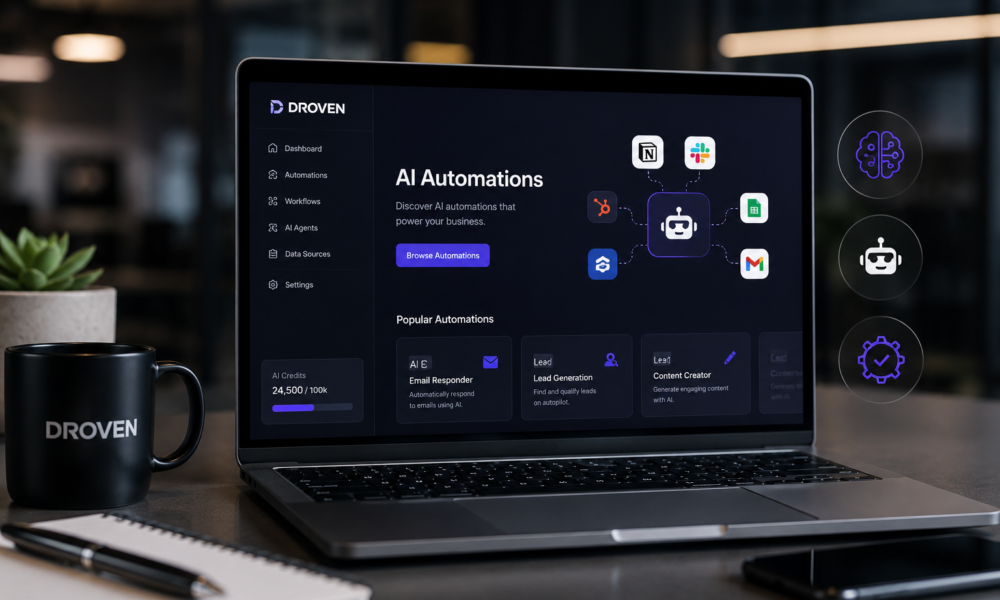
Droven io ai automation tools is a knowledge platform that helps businesses evaluate AI automation tools before investing. Droven io AI automation tools analysis covers feature benchmarking, integration compatibility, cost modeling, and ROI projections—giving companies the intelligence to choose the right automation stack with confidence.
Table Of Content
- What Are Droven io AI Automation Tools?
- Core Features of Droven io AI Automation Tools Analysis
- Key Capabilities and Use Cases
- How to Evaluate AI Automation Tools with Droven ion
- How Does Droven io Compare to Other AI Tool Evaluation Platforms?
- What to Know About AI Automation Tools in 2026
- Common Mistakes When Selecting AI Automation Tools
- Best Practices for Implementing AI Automation Tools
- Making the Right AI Automation Decision Starts Before Day One
- Frequently Asked Questions
The AI automation market has never been more crowded. Hundreds of platforms promise to streamline workflows, eliminate manual tasks, and unlock new levels of operational efficiency. But choosing the wrong tool—or worse, deploying several that don’t work together—can cost organizations tens of thousands of dollars and months of lost productivity.
That’s the core problem Droven io was built to solve. Rather than selling AI automation software directly, Droven io operates as a knowledge and evaluation platform: a dedicated resource where businesses can assess, compare, and benchmark AI automation tools before committing a single dollar to implementation.
This post breaks down exactly what Droven io AI automation tools analysis covers, how the platform’s capabilities work in practice, and what businesses need to know about the AI automation landscape heading into 2026.
What Are Droven io AI Automation Tools?
Droven io ai automation tools is not an AI automation tool itself—and that distinction matters. Droven io is a knowledge platform purpose-built to evaluate AI automation solutions. Businesses use Droven io to identify which tools align with their specific workflows, technical environments, and budget constraints before making purchasing or implementation decisions.
The platform fills a significant gap. Most organizations approach AI tool selection reactively: a vendor pitches a solution, a demo impresses the team, and a contract gets signed without a thorough evaluation of how the tool performs in real business conditions. Droven io AI automation tools analysis introduces structure and objectivity into that process
How does Droven io help businesses assess AI automation tools?
Droven io approaches tool evaluation across three core dimensions:
- Comparative analysis: Side-by-side breakdowns of competing AI automation platforms, covering functionality, performance, and vendor reliability.
- Feature-level breakdowns: Granular assessments of what each tool actually does—not what the marketing says it does.
- ROI modeling: Cost-benefit projections that account for licensing, implementation, training, and ongoing maintenance, helping businesses understand the true total cost of ownership.
Together, these capabilities give decision-makers a clear, evidence-based picture of which tools are worth pursuing.
Core Features of Droven io AI Automation Tools Analysis
Comprehensive tool comparison and benchmarking
Droven io ai automation tools benchmarks AI automation platforms against standardized criteria, making it possible to evaluate tools on a level playing field. Businesses can compare document processing accuracy, workflow automation capabilities, integration depth, and user experience—all in one place.
Feature-by-feature analysis across platforms
Where vendor-provided comparisons tend to highlight strengths and minimize weaknesses, Droven ion’s feature analysis is designed to be exhaustive. This means surfacing limitations alongside capabilities, so businesses don’t encounter costly surprises post-implementation.
Integration compatibility assessments
One of the most common and expensive AI implementation failures stems from integration friction. Droven io evaluates how well each tool connects with existing business systems—CRMs, ERPs, data warehouses, and communication platforms—and flags potential compatibility issues before they become real problems.
Cost analysis and ROI calculators
Droven io provides cost modeling tools that factor in licensing tiers, implementation timelines, training overhead, and expected efficiency gains. For businesses building a business case for AI automation investment, this data is invaluable.
Key Capabilities and Use Cases
Droven io AI automation tools coverage spans a wide range of business functions and automation categories
Workflow automation evaluation for business operations
Different departments have different automation needs. Droven io helps businesses identify tools suited to finance automation, HR processes, operations, and project management—matching tool capabilities to specific functional requirements rather than offering generic recommendations.
Document processing and data extraction tool assessment
AI-powered document processing has matured significantly, but performance varies widely across vendors. Droven io evaluates extraction accuracy, document type support, and processing speed to help businesses identify the right platform for their document-heavy workflows.
Customer service and chatbot platform comparisons
With conversational AI becoming a front-line customer service tool, choosing the right chatbot or AI agent platform carries real business risk. Droven io’s assessments cover response quality, escalation handling, CRM integration, and total deployment cost.
Industry-specific AI automation recommendations
A financial services firm and a logistics company have fundamentally different automation requirements. Droven io provides industry-contextualized recommendations, accounting for regulatory requirements, workflow complexity, and the maturity of AI tooling within specific sectors.
How to Evaluate AI Automation Tools with Droven ion
Droven io structures the evaluation process into a clear, repeatable framework that reduces guesswork and keeps stakeholders aligned.
Step 1: Define your automation needs and business objectives
Start with a clear articulation of what you want to automate, why it matters, and what success looks like. Vague objectives lead to vague results.
Step 2: Use Droven io’s platform to compare relevant tool
With your requirements defined, use Droven io to filter and compare platforms that match your functional and technical parameters.
Step 3: Analyze feature gaps and integration requirements
No tool will be a perfect fit. Droven io helps businesses identify where gaps exist and assess whether those gaps are bridgeable through configuration, workarounds, or complementary tools.
Step 4: Review cost structures and expected ROI
Use Droven io’s cost modeling to pressure-test your assumptions about pricing, implementation timelines, and expected efficiency gains.
Step 5: Make data-driven decisions before implementation
Armed with comparative data, feature analysis, and ROI projections, businesses can enter vendor negotiations and implementation planning with confidence.
How Does Droven io Compare to Other AI Tool Evaluation Platforms?
The market for AI tool intelligence platforms is growing, but most options fall into two categories: analyst firms that publish high-level reports, and vendor comparison sites that depend on self-reported data and advertiser relationships.
Droven io AI automation tools analysis occupies a different position. The platform’s methodology prioritizes transparency and independence—benchmarks are standardized, not shaped by vendor relationships, and feature assessments go deeper than most analyst-grade reports.
For businesses that need actionable, implementation-ready intelligence rather than high-level market maps, that depth makes a meaningful difference. Droven io also incorporates implementation guidance and customer success metrics into its evaluations, connecting the pre-purchase assessment to real-world deployment outcomes.
What to Know About AI Automation Tools in 2026
The AI automation landscape in 2026 is defined by several intersecting trends that businesses need to factor into their tool selection.
The rise of no-code and low-code automation platforms
Enterprise AI automation is no longer the exclusive domain of development teams. No-code and low-code platforms have matured to the point where operations, marketing, and finance teams can build and deploy automations independently. Evaluating these platforms requires a different lens—one focused on governance, scalability, and IT oversight as much as ease of use.
Security, compliance, and data privacy as selection criteria
Regulatory pressure is intensifying across industries. GDPR, CCPA, and sector-specific frameworks like HIPAA and SOC 2 have elevated data privacy from a checkbox to a primary evaluation criterion. Droven io’s assessments incorporate compliance considerations, helping businesses avoid tools that create regulatory exposure.
Industry-specific AI automation solutions
General-purpose automation platforms are losing ground to purpose-built vertical solutions. Healthcare, legal, manufacturing, and financial services all now have AI automation tools designed specifically for their workflows and regulatory environments. Droven ion tracks this specialization, making it easier for businesses to find domain-appropriate solutions.
Integration ecosystems and composable AI architectures
Modern enterprises don’t buy single platforms—they build stacks. The ability of an AI automation tool to integrate cleanly into existing systems, share data across platforms, and participate in a composable architecture has become a critical evaluation factor. Droven ion’s integration compatibility assessments are specifically designed to address this.
Common Mistakes When Selecting AI Automation Tools
Even well-resourced organizations make avoidable errors during AI tool selection. The following mistakes consistently derail automation initiatives.
- Choosing tools based on hype rather than business needs. High-profile AI platforms generate significant media attention, but brand recognition is a poor proxy for fit. The right tool is the one that solves your specific problem, not the one that generated the most LinkedIn posts.
- Underestimating total cost of ownership. Licensing fees are typically the smallest component of AI automation investment. Implementation, integration, training, and ongoing optimization can easily multiply the initial cost by two to three times. Droven io’s cost modeling surfaces these figures upfront.
- Failing to plan for change management. Technology adoption fails more often due to human resistance than technical limitations. Businesses that invest in stakeholder alignment, training, and phased rollout consistently outperform those that treat implementation as a purely technical exercise.
- Not evaluating vendor stability. The AI software market is volatile. Vendors raise funding, pivot strategies, get acquired, or shut down. Droven io’s evaluations incorporate vendor health metrics to reduce the risk of building critical workflows on an unstable foundation.
- Overlooking security and compliance requirements. Discovering post-implementation that a tool doesn’t meet your compliance standards is an expensive mistake. Evaluate security architecture and data handling policies before signing any contracts.
Best Practices for Implementing AI Automation Tools
Selection is only the beginning. Successful AI automation implementation requires a disciplined approach from scoping through optimization.
- Start with clearly defined automation opportunities. The highest-value automations typically involve high-volume, repetitive tasks with well-defined rules. Start there before tackling complex, judgment-intensive processes.
- Use platforms like Droven ion to guide tool selection. Evaluation intelligence reduces implementation risk and compresses the time between vendor assessment and go-live.
- Plan for training and organizational change. Allocate budget and timeline for user enablement. Tools that teams don’t understand or trust won’t deliver their projected value.
- Establish performance baselines before deployment. Without pre-implementation benchmarks, measuring the impact of automation is guesswork.
- Review and optimize continuously. AI automation tools evolve rapidly. Regular performance reviews ensure your workflows stay aligned with current capabilities and business needs.
Making the Right AI Automation Decision Starts Before Day One
The businesses that get the most from AI automation are rarely those with the biggest budgets. They’re the ones that invest in rigorous evaluation before implementation—testing assumptions, modeling costs, and identifying integration requirements before committing to a platform.
Droven io AI automation tools analysis exists to make that rigor accessible. By providing comparative benchmarks, feature-level transparency, integration assessments, and ROI modeling, Droven io gives businesses the intelligence to select automation tools with confidence—and avoid the costly mistakes that come from selecting tools without it.
The AI automation landscape will keep accelerating. The competitive advantage goes to organizations that evaluate deliberately, implement strategically, and optimize continuously.
Also Read This: GFXRobotection AI Software by GFXMaker: Complete Review, Features, Benefits & Performance
Frequently Asked Questions
What is Droven ion, and how is it different from an AI automation tool?
Droven ion is a knowledge and evaluation platform, not an AI automation tool itself. Droven ion helps businesses assess, compare, and benchmark AI automation solutions before purchasing or implementing them—providing feature analysis, integration assessments, and ROI modeling to support informed decision-making.
What types of AI automation tools does Droven io evaluate?
Droven io AI automation tools coverage spans workflow automation platforms, document processing and data extraction tools, customer service and chatbot platforms, and industry-specific automation solutions across sectors including finance, healthcare, logistics, and operations.
How does Droven ion ensure its tool evaluations are unbiased?
Droven io uses standardized benchmarking criteria and feature assessment methodologies that are not shaped by vendor advertising relationships. The goal is to provide objective, implementation-ready intelligence rather than vendor-influenced rankings.
What are the most important factors to evaluate when selecting an AI automation tool in 2026?
Key evaluation factors include integration compatibility with existing systems, total cost of ownership (licensing plus implementation and training), security and compliance architecture, vendor stability, and the availability of no-code or low-code deployment options depending on your technical team’s capacity.
How long does it typically take to implement an AI automation tool?
Implementation timelines vary significantly based on tool complexity and integration requirements. Simple workflow automations can go live in weeks, while enterprise-grade deployments involving deep system integrations may take several months. Droven io’s evaluations surface realistic implementation timelines as part of the cost and ROI modeling process.
Who benefits most from using Droven ion before investing in AI automation?
Droven io is most valuable for mid-market and enterprise organizations that are evaluating multiple AI automation platforms, building internal business cases for automation investment, or looking to avoid the costly mistakes that come from selecting tools based on vendor marketing alone.




[…] ALSO READ : Droven io AI Automation Tools: Features, Capabilities, and What to Know in 2026 […]