




Drovenio Latest Technology News: Trends, Updates & Innovations in 2026
Drovenio latest technology news covers the most significant developments across AI, cloud computing, cybersecurity, consumer gadgets, and emerging technologies in 2026. From agentic AI systems...

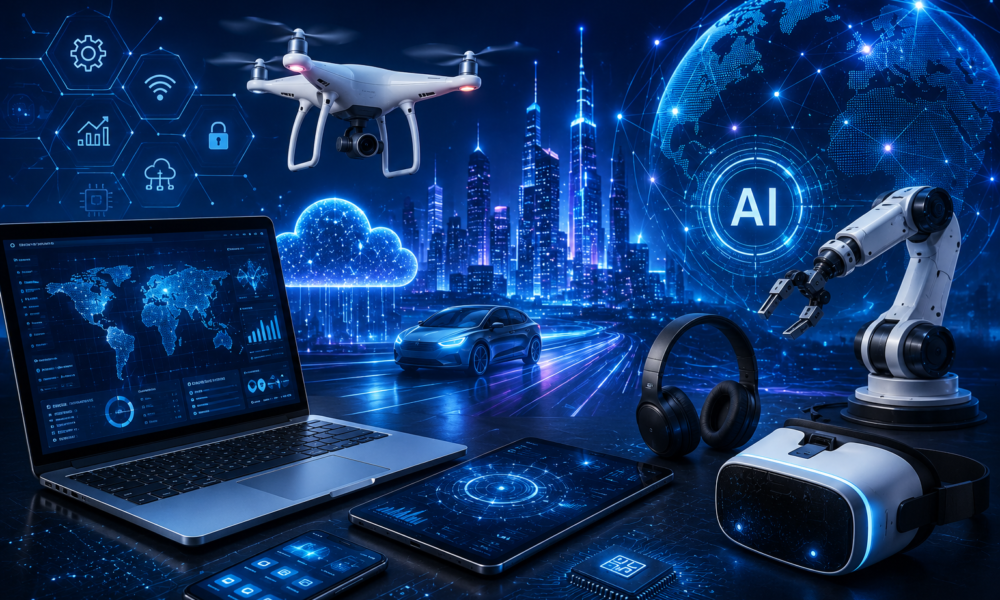
Drovenio latest technology news covers the most significant developments across AI, cloud computing, cybersecurity, consumer gadgets, and emerging technologies in 2026. From agentic AI systems reshaping how businesses operate to quantum-ready encryption protocols, this roundup breaks down what’s changing, why it matters, and what to watch next.
Table Of Content
- AI Trends & Updates: What’s Driving Artificial Intelligence in 2026?
- What is agentic AI, and why does it matter for businesses?
- How is multimodal AI changing content creation and data analysis?
- Cloud Computing Developments: What’s New in Cloud Infrastructure in 2026?
- What is the shift from multi-cloud to intelligent cloud orchestration?
- How is edge computing changing real-time data processing?
- Cybersecurity News & Innovations: How Is the Threat Landscape Evolving in 2026?
- What are the biggest cybersecurity threats businesses face in 2026?
- What is quantum-ready encryption, and when should businesses start preparing?
- Latest Gadgets & Consumer Tech: What Devices Are Worth Watching in 2026?
- What are the most significant consumer tech releases in 2026?
- How is spatial computing influencing consumer behavior and enterprise adoption?
- Emerging Technologies Shaping Global Industries in 2026
- How is synthetic biology transforming manufacturing and healthcare?
- What role does green technology play in the 2026 tech landscape?
- How is automation technology changing the global labor market?
- Staying Ahead: How to Use Drovenio Technology News to Make Smarter Decisions
- Frequently Asked Questions
Technology moves fast. Keeping up with it shouldn’t feel like a full-time job—but for businesses, developers, and everyday consumers, missing a major shift can mean falling behind. Drovenio latest technology news exists to cut through the noise and deliver what actually matters.
This post covers the most important technology developments of 2026 across five major domains: artificial intelligence, cloud computing, cybersecurity, consumer gadgets, and emerging technologies reshaping entire industries. Each section is designed to give you a clear, practical understanding of what’s happening and why it’s relevant—whether you’re a tech professional, a business decision-maker, or simply someone who wants to stay informed.
By the end of this post, you’ll have a comprehensive view of the technology landscape in 2026, complete with key trends, notable innovations, and actionable takeaways.
AI Trends & Updates: What’s Driving Artificial Intelligence in 2026?
Artificial intelligence has shifted from a promising technology to a foundational business tool. According to McKinsey’s 2025 State of AI report, over 72% of global organizations had adopted AI in at least one business function—a significant jump from 55% the year prior. In 2026, that adoption has deepened, and the nature of AI itself has evolved.
What is agentic AI, and why does it matter for businesses?
The biggest story in AI right now is the rise of agentic AI systems—autonomous programs capable of executing multi-step tasks with minimal human input. Unlike traditional AI tools that respond to prompts, agentic AI can plan, reason, and take action across connected platforms. Companies like OpenAI, Google DeepMind, and Anthropic are all actively developing and deploying these systems.
For businesses, this shift is significant. Agentic AI can handle everything from scheduling and data retrieval to complex research workflows, reducing the time employees spend on repetitive cognitive tasks.
How is multimodal AI changing content creation and data analysis?
Multimodal AI—models that process text, images, audio, and video simultaneously—has matured considerably. Tools built on models like GPT-5 and Gemini Ultra can now generate cohesive video scripts alongside storyboards, analyze customer sentiment from call recordings, and produce research summaries from mixed-format data.
For marketing, operations, and customer service teams, multimodal AI isn’t just a productivity boost. It’s fundamentally changing what small teams can produce without additional headcount.
Cloud Computing Developments: What’s New in Cloud Infrastructure in 2026?
Cloud computing is no longer a differentiator—it’s a baseline. The competition in 2026 centers on what’s built on top of the cloud rather than the cloud itself.
What is the shift from multi-cloud to intelligent cloud orchestration?
Multi-cloud strategies—using multiple providers like AWS, Azure, and Google Cloud simultaneously—have been standard practice for several years. In 2026, the focus has shifted to intelligent cloud orchestration: using AI-powered tools to automatically manage workloads across providers based on cost, latency, and compliance requirements.
Platforms like Pulumi, Crossplane, and native cloud AI services now offer organizations dynamic workload routing that can reduce cloud spend by 20–35%, according to Gartner’s 2026 Cloud Cost Optimization Report.
How is edge computing changing real-time data processing?
Edge computing—processing data closer to where it’s generated rather than sending it to centralized servers—continues its rapid expansion. The rollout of 5G infrastructure across North America, Europe, and parts of Asia has accelerated edge deployments in manufacturing, healthcare, and autonomous vehicles.
For industries that rely on real-time decisions, edge computing reduces latency from hundreds of milliseconds to single digits. That difference is the gap between a self-driving vehicle reacting safely and not.
Cybersecurity News & Innovations: How Is the Threat Landscape Evolving in 2026?
Cybersecurity has always been a game of adaptation, but the arrival of AI-powered attacks has raised the stakes considerably. Drovenio latest technology news tracks cybersecurity developments closely because the implications extend well beyond IT departments.
What are the biggest cybersecurity threats businesses face in 2026?
Three threat categories dominate the 2026 landscape:
- AI-generated phishing attacks: Generative AI now enables attackers to craft highly personalized phishing emails at scale, mimicking writing styles, job titles, and internal company language with alarming accuracy. According to Proofpoint’s 2026 Human Factor Report, AI-assisted phishing attacks increased by 48% year-over-year.
- Deepfake-based fraud: Audio and video deepfakes are being used to impersonate executives in real-time video calls, tricking finance teams into approving fraudulent transfers. Several high-profile incidents in early 2026 highlighted the need for multi-factor identity verification in financial approvals.
- Ransomware-as-a-service (RaaS): Criminal organizations continue to offer ransomware toolkits to less sophisticated actors, lowering the barrier for attacks on small and mid-sized businesses.
What is quantum-ready encryption, and when should businesses start preparing?
Quantum computing poses a long-term threat to current encryption standards. While large-scale quantum computers capable of breaking RSA encryption don’t yet exist commercially, the U.S. National Institute of Standards and Technology (NIST) finalized its first set of post-quantum cryptographic standards in 2024. Security-forward organizations are already beginning migration planning.
The recommendation from most cybersecurity experts: businesses should audit their current encryption usage now and develop a migration roadmap, even if full implementation is still years away.
Latest Gadgets & Consumer Tech: What Devices Are Worth Watching in 2026?
Consumer technology in 2026 is defined by two forces: the miniaturization of AI and the blurring of physical and digital environments.
What are the most significant consumer tech releases in 2026?
- AI-powered smart glasses: Following the commercial success of Meta’s Ray-Ban smart glasses, multiple hardware manufacturers—including Samsung and Google—have released second-generation AR glasses with real-time translation, contextual information overlays, and AI assistant integration. These devices are increasingly practical rather than experimental.
- Neuromorphic processors in consumer devices: Chipmakers including Intel and Qualcomm have begun embedding neuromorphic chips—processors that mimic the brain’s neural architecture—into flagship smartphones and laptops. These chips dramatically improve energy efficiency for AI inference tasks, extending battery life while enabling on-device AI without cloud dependency.
- Health-monitoring wearables with FDA clearance: Smartwatches from Apple, Samsung, and newer entrants like Withings now offer continuous glucose monitoring and early atrial fibrillation detection with FDA-cleared accuracy. The wearable health tech market is projected to reach $186 billion by 2030, according to Grand View Research.
How is spatial computing influencing consumer behavior and enterprise adoption?
Apple’s Vision Pro and its successors have pushed spatial computing—the integration of digital content into physical environments—from novelty to niche utility. Enterprise adoption has outpaced consumer adoption, with architecture firms, surgical training programs, and remote collaboration platforms leading real-world deployment.
Consumer interest is growing, but mainstream adoption still hinges on price reduction and comfort improvements. The next 18–24 months will be telling.
Emerging Technologies Shaping Global Industries in 2026
Beyond the headline categories, several technologies are quietly reshaping entire sectors at the infrastructure level.
How is synthetic biology transforming manufacturing and healthcare?
Synthetic biology—engineering biological systems to produce specific outcomes—is moving from research labs into commercial production. Companies are now using engineered microbes to produce sustainable materials, pharmaceuticals, and even food ingredients at industrial scale. The global synthetic biology market is expected to exceed $50 billion by 2028, per Allied Market Research.
In healthcare, synthetic biology is enabling personalized cancer therapies that target tumor-specific mutations rather than relying on generalized chemotherapy protocols.
What role does green technology play in the 2026 tech landscape?
Sustainability has become a design requirement, not an afterthought. From data centers powered entirely by renewable energy to electric vertical take-off and landing (eVTOL) aircraft entering commercial flight tests, the intersection of technology and environmental accountability is producing genuinely novel solutions.
The EU’s Corporate Sustainability Reporting Directive (CSRD), which came into full effect in 2025, is pushing large enterprises to quantify and disclose their environmental impact—driving demand for energy-efficient infrastructure and carbon tracking software.
How is automation technology changing the global labor market?
Robotics and automation are expanding beyond manufacturing floors into logistics, agriculture, and service industries. Humanoid robots from companies like Figure AI and Boston Dynamics are being piloted in warehouse environments, handling tasks that previously required human dexterity.
The World Economic Forum’s Future of Jobs Report 2025 projects that automation will displace 85 million jobs globally by 2030—but create 97 million new ones. The net positive outlook depends heavily on investment in reskilling and workforce transition programs.
Staying Ahead: How to Use Drovenio Technology News to Make Smarter Decisions
Technology doesn’t wait. The organizations and individuals who thrive are those who treat staying informed as an active discipline rather than a passive one.
Drovenio latest technology news provides ongoing coverage across AI, cloud computing, cybersecurity, consumer tech, and emerging innovations—giving you the context to make better decisions faster. Whether you’re evaluating a new software investment, preparing for regulatory changes, or simply trying to understand how a technology like agentic AI might affect your industry, consistent exposure to credible, well-structured reporting is your most valuable asset.
Bookmark Drovenio’s technology news hub, share relevant updates with your team, and revisit this guide as the year progresses. Technology trends are not static—and neither should your understanding of them be.
Frequently Asked Questions
What does Drovenio latest technology news cover?
Drovenio latest technology news covers developments across artificial intelligence, cloud computing, cybersecurity, consumer gadgets, and emerging technologies shaping global industries. The content is designed to be accessible to both technical and non-technical readers.
What are the most important AI trends to watch in 2026?
The two most significant AI trends in 2026 are agentic AI—autonomous systems capable of completing multi-step tasks independently—and multimodal AI, which processes text, images, audio, and video simultaneously. Both are driving major changes in how businesses operate and how content is created.
How should small businesses approach cybersecurity in 2026?
Small businesses should prioritize multi-factor authentication, employee phishing awareness training, and regular software patching. Given the rise of AI-generated phishing attacks (up 48% year-over-year per Proofpoint), human error remains the most exploited vulnerability. Consider managed security service providers (MSSPs) if an in-house security team isn’t feasible.
Is quantum computing a real threat to business data security right now?
Not immediately, but planning should begin now. Large-scale quantum computers capable of breaking standard encryption do not yet exist commercially. However, NIST has already finalized post-quantum cryptographic standards, and forward-thinking organizations are auditing their encryption infrastructure in preparation.
What consumer tech developments are worth investing in for 2026?
AI-powered smart glasses and FDA-cleared health wearables represent the strongest consumer value propositions in 2026. For businesses, spatial computing tools and neuromorphic chip-enabled devices offer practical productivity and collaboration improvements worth evaluating.
What industries are most affected by emerging technologies in 2026?
Healthcare, manufacturing, logistics, and energy are experiencing the most significant disruption. Synthetic biology is transforming pharmaceutical production and material manufacturing. Green technology is reshaping energy infrastructure. Robotics and automation are restructuring logistics and warehousing operations globally.





No Comment! Be the first one.