





10 Latest AI Tools You Should Try in 2026
AI tools in 2026 are smarter, faster, and more accessible than ever. From generative content platforms to industry-specific AI solutions, this guide covers the 10 most impactful AI tools transforming...

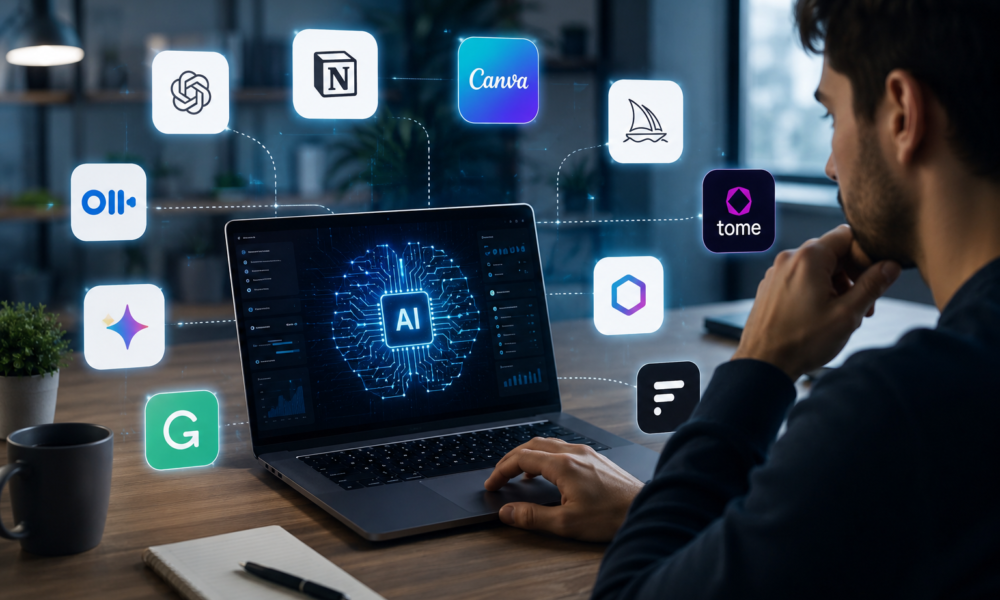
AI tools in 2026 are smarter, faster, and more accessible than ever. From generative content platforms to industry-specific AI solutions, this guide covers the 10 most impactful AI tools transforming how professionals work—so you can identify which ones are worth your time and investment.
Table Of Content
- 1. Generative AI for Content Creation {#1}
- 2. AI-Powered Analytics and Business Intelligence {#2}
- 3. Advanced AI for Code Development {#3}
- 4. AI-Driven Customer Service Solutions {#4}
- 5. Creative AI Tools for Design and Media {#5}
- 6. AI for Research and Knowledge Management {#6}
- 7. Specialized AI for Specific Industries {#7}
- 8. AI Collaboration and Productivity Platforms {#8}
- 9. Security and Privacy-Focused AI Tools {#9}
- 10. Emerging Frontier AI Technologies {#10}
- Frequently Asked Questions About AI Tools in 2026
- Which AI Tools Should You Prioritize in 2026?
The pace of AI development has shifted gears. What once felt like science fiction—machines writing entire marketing campaigns, diagnosing diseases, generating photorealistic visuals—is now standard practice across industries.
2026 has arrived as a turning point. Enterprises and solo creators alike are moving beyond experimentation and into full-scale AI adoption. According to McKinsey’s 2024 State of AI report, over 65% of organizations regularly use generative AI tools—nearly double the adoption rate from the previous year. That momentum has only accelerated since.
But with hundreds of tools flooding the market, knowing which ones actually deliver is the real challenge. This guide cuts through the noise, covering 10 categories of AI tools that are making a measurable difference—complete with standout platforms, real-world use cases, and tips to get the most out of each.
1. Generative AI for Content Creation {#1}
Generative AI writing platforms have moved well past basic text generation. Tools like Jasper and Copy.ai now offer brand voice training, multi-channel campaign creation, and SEO optimization built directly into the workflow.
For marketers and content teams, the productivity gains are substantial. Jasper, for example, enables users to produce entire blog posts, email sequences, and ad copy within a single workspace—maintaining brand consistency across every asset.
Best for: Marketing teams, bloggers, and content agencies managing high-volume output.
Pro tip: Use generative AI tools for first-draft creation and ideation, then apply human editing to ensure accuracy and voice authenticity. The combination consistently outperforms either approach alone.
2. AI-Powered Analytics and Business Intelligence {#2}
Raw data means nothing without context. AI-powered analytics platforms like ThoughtSpot and Microsoft Fabric allow business users—not just data scientists—to query datasets using plain English and receive instant, visual insights.
These platforms integrate with existing systems like Salesforce, SAP, and Google Analytics, making adoption relatively frictionless. For financial analysis, market research, and strategic planning, the ability to surface patterns in real time is a significant competitive edge.
Best for: Business analysts, finance teams, and executives who need fast, reliable data interpretation without deep technical skills.
3. Advanced AI for Code Development {#3}
AI coding assistants have fundamentally changed software development timelines. GitHub Copilot remains the industry standard, supporting over 15 programming languages and integrating natively into VS Code, JetBrains, and other popular IDEs. A 2023 GitHub study found that developers using Copilot completed tasks up to 55% faster compared to those working without AI assistance.
Newer entrants like Cursor take this further by offering an AI-native code editor that can understand and refactor entire codebases—not just individual lines. For debugging and code review, these tools are reducing error rates and shortening development cycles across the board.
Best for: Software developers, engineering teams, and technical founders looking to ship faster without sacrificing code quality.
4. AI-Driven Customer Service Solutions {#4}
Customer expectations have never been higher—and AI-driven support platforms are rising to meet them. Intercom’s Fin AI and Zendesk AI now deploy conversational agents capable of resolving complex queries, escalating edge cases to human agents, and personalizing responses based on customer history.
Unlike older rule-based chatbots, these systems use large language models to understand intent rather than just keywords. The result: higher resolution rates, lower support costs, and customers who feel genuinely heard. According to Zendesk’s 2024 CX Trends Report, companies using AI-powered support saw a 30% reduction in average handle time.
Best for: E-commerce businesses, SaaS companies, and any organization managing high volumes of inbound customer queries.
5. Creative AI Tools for Design and Media {#5}
The creative industry has been transformed by AI image generators and video creation platforms. Midjourney continues to lead in AI image generation, producing photorealistic and stylized visuals that rival professional photography for many marketing applications. For video, Runway ML enables creators to generate, edit, and enhance video content at a fraction of traditional production costs.
For brand teams, these tools aren’t about replacing designers—they’re about expanding what small creative teams can produce. A two-person marketing team can now ideate, prototype, and launch a full visual campaign in days rather than weeks.
Best for: Marketing and creative teams, brand agencies, and content creators building social media, ad, and brand assets.
6. AI for Research and Knowledge Management {#6}
Synthesizing information from large volumes of documents, research papers, and internal data used to require entire teams. AI-powered research tools like Perplexity AI and Elicit change the equation entirely.
Elicit, designed specifically for academic and scientific research, can analyze hundreds of papers, extract key findings, and identify contradictions—tasks that would take a human researcher weeks. Perplexity AI functions as a real-time, citation-backed search engine, surfacing verifiable answers drawn from current web sources.
Best for: Researchers, knowledge workers, healthcare professionals, and enterprise teams dealing with high volumes of complex information.
7. Specialized AI for Specific Industries {#7}
General-purpose AI is powerful, but purpose-built industry AI delivers precision that broad platforms simply cannot match.
- Healthcare: Nabla uses ambient AI to generate clinical documentation during patient consultations, reducing physician administrative burden by up to 70% according to internal case studies.
- Finance: Kensho (a subsidiary of S&P Global) applies machine learning to financial data analysis, regulatory compliance monitoring, and risk assessment at scale.
- Legal: Harvey AI assists legal professionals with contract review, due diligence, and legal research—trained specifically on legal corpora to minimize hallucination risks common in general-purpose models.
Best for: Professionals in regulated industries who need AI tools that understand domain-specific language, compliance requirements, and professional standards.
8. AI Collaboration and Productivity Platforms {#8}
The modern workplace generates enormous amounts of information—meetings, emails, Slack messages, project updates. AI collaboration platforms help teams cut through the noise and focus on what matters.
Notion AI enables teams to summarize meeting notes, generate project briefs, and surface relevant information from across a shared workspace. Microsoft 365 Copilot embeds AI assistance directly into Word, Excel, PowerPoint, and Teams—automating routine tasks without requiring users to switch between applications.
For distributed and remote teams especially, these platforms reduce the coordination overhead that eats into productive work time.
Best for: Remote teams, project managers, and knowledge workers spending too much time on administrative and coordination tasks.
9. Security and Privacy-Focused AI Tools {#9}
As AI adoption accelerates, so do the risks. Organizations handling sensitive data need AI tools that deliver insights without compromising security or violating regulations like GDPR and CCPA.
Nightfall AI scans cloud environments and SaaS applications for sensitive data exposure in real time, using machine learning to detect patterns that rule-based systems miss. Private AI enables organizations to redact and anonymize personal information from datasets before feeding them into AI models—critical for healthcare, finance, and legal applications.
Best for: IT and security teams, compliance officers, and any organization processing personal or regulated data through AI systems.
10. Emerging Frontier AI Technologies {#10}
The most exciting category is also the hardest to define—because the tools pushing the frontier today will likely be mainstream within 18 months.
Multimodal AI platforms like GPT-4o and Google Gemini can simultaneously process and generate text, images, audio, and video—opening up use cases that single-modality models cannot address. OpenAI’s o3 represents the leading edge of reasoning-focused AI, designed for complex problem-solving tasks in math, science, and coding.
These aren’t experimental projects—they’re increasingly production-ready tools that forward-looking teams are already integrating into core workflows.
Best for: Technology leaders, AI researchers, and early adopters seeking to build future-ready capabilities before they become industry standard.
Frequently Asked Questions About AI Tools in 2026
What are the best AI tools for beginners in 2026?
For users new to AI, Jasper and Notion AI offer the most accessible entry points. Both tools are designed for non-technical users and integrate into familiar workflows. Perplexity AI is also an excellent starting point for research tasks, as it works similarly to a standard search engine.
Are AI tools in 2026 suitable for small businesses?
Yes. Most leading AI platforms—including Jasper, Copy.ai, and Intercom’s Fin AI—offer tiered pricing that accommodates small business budgets. Many provide free plans or trial periods, making it practical to evaluate tools before committing.
How do AI tools in 2026 protect user privacy?
Privacy protections vary significantly between tools. Platforms like Nightfall AI and Private AI are built specifically around data protection. For general-purpose tools, review each provider’s data handling policies—particularly whether your inputs are used to train future models, which is a critical consideration for businesses handling confidential information.
What is the difference between general AI tools and industry-specific AI tools?
General AI tools like GPT-4o are trained on broad datasets and handle a wide range of tasks. Industry-specific tools like Harvey AI (legal) or Nabla (healthcare) are trained on domain-specific data and optimized for accuracy in regulated or specialized contexts. Choose industry-specific tools when precision, compliance, and domain expertise are non-negotiable.
Will AI tools replace jobs in 2026?
The evidence suggests AI tools augment rather than replace skilled workers—at least in the short term. According to the World Economic Forum’s Future of Jobs Report 2025, AI is expected to create more roles than it displaces through 2030, though the nature of many jobs will shift significantly. The professionals most at risk are those who choose not to develop AI literacy.
ALSO READ : ChatGPT vs DeepSeek: Which AI Platform Wins in 2026?
Which AI Tools Should You Prioritize in 2026?
The honest answer: it depends on your role, your industry, and where your biggest productivity gaps are.
Content teams get the fastest ROI from generative AI writing platforms. Development teams will find the most immediate impact in AI coding assistants. Organizations managing customer experience at scale should prioritize AI-driven support solutions.
The mistake most organizations make is trying to implement every available tool simultaneously. A more effective approach is to identify the one or two workflows that consume the most time and introduce AI tools specifically targeted at those areas first. Measure the impact, build internal confidence, and expand from there.
2026 is the year practical AI adoption becomes standard practice—not a differentiator, but a baseline expectation. The organizations building those capabilities now will have a meaningful head start by the time these tools reach universal adoption.
Start with one tool from this list. Commit to using it consistently for 30 days. The results will make the next decision easier.






[…] ALSO READ : 10 Latest AI Tools You Should Try in 2026 […]
[…] ALSO READ : 10 Latest AI Tools You Should Try in 2026 […]